
Project
Cider in Asturian Emigration
A visual record of a shared culture: a book, virtual exhibition and open documentary project on cider in Asturian emigration. Exhibition curator: Llucía Fernández Marqués.
Key facts
- Type
- Project
Presentation
A Fundación Asturies XXI project that recovers and shares the visual history of cider culture in Asturian emigrant communities. Photographs, posters, labels and documents show cider’s presence in social life and trade during the nineteenth and twentieth centuries.
Language, memories and ways of gathering travelled with the people who emigrated. Cider remained a link to Asturias: it accompanied family gatherings, celebrations and the activities of Asturian communities in their host countries.
The photographs in the book bring this history into everyday life: shared tables, festivities, shops and spaces for social interaction. Posters and labels show how images of Asturias accompanied the circulation of bottles. Demand from emigrant communities, exports and the development of the cider industry formed part of the same history of ties, exchanges and belonging.
This visual journey invites us to discover and preserve the documents that tell the story of Asturian emigration and the transmission of cider culture to new generations.
Project facts
Read the book
La sidre na emigración asturiana
A visual record of a shared culture
A journey through photographs, posters and labels documenting cider in Asturian emigration, community life and trade between Asturias and the Americas.
48 pages. Original PDF: 26.78 MB (26,781,933 bytes). Web version: 11.64 MB (11,638,202 bytes).
The reading link opens the web version in a new tab. The download provides the original PDF. The book is available in its original Asturian edition.
Documentary timeline
A journey through cider’s presence in emigration and transatlantic trade between 1870 and 1947. Each date links directly to the corresponding exhibition item.
* The identification of Mexico in the 1900 item is probable rather than definitive.
Cider around the world
The project documents a network of cultural and commercial circulation originating in Asturias and extending across different parts of the Americas. This documentary map groups items by location and offers a geographical route into the exhibition.
Asturias
Villaviciosa, 1920 · shipping and exports. The final items also document Asturian production, advertising and labelling.
Cuba
Cuba, 1885 · Havana, 1917 · Havana, 1924 · Cuba, 1925 · Havana, 1925 · Havana, 1929 · Havana, 1932.
Mexico
Mexico, 1870 · Mexico*, 1900. Cider appears in both everyday settings and the life of emigrant communities.
Argentina
Buenos Aires, 1922 · Buenos Aires, 1925 · Buenos Aires, 1925 · Argentina, 1930 · Argentina, 1947 · Buenos Aires, date unknown.
Other documented destinations
The international labelling in item 20 also mentions Venezuela, Puerto Rico, Uruguay and Chile, alongside Cuba, Argentina and Mexico.
Virtual exhibition
A complete journey through the book’s 20 items, in their original order. Select an image to enlarge it.
Introduction
Asturian emigration carried much more than people across the Atlantic. Language, memories, ways of gathering and a cider culture that remained a link to the homeland travelled with them. Cider accompanied family gatherings, celebrations and the activities of Asturian communities, finding new spaces in their host countries.
This book offers a visual journey through that shared history. The photographs show tables, festivities, shops and social spaces where cider formed part of emigrant life. Posters and labels broaden the picture, revealing how images of Asturias also accompanied the circulation of bottles.
The journey also explores the relationship between demand from emigrant communities, exports and the development of the Asturian cider industry. Through these records, trade and everyday life appear connected in a shared history of ties, exchanges and belonging.
Looking at these images brings us closer to the people who kept their relationship with their homeland alive and passed their customs to new generations. This visual record invites us to recognise cider as part of our shared culture and value the documents that help us discover, preserve and tell the history of Asturian emigration.
Back to contents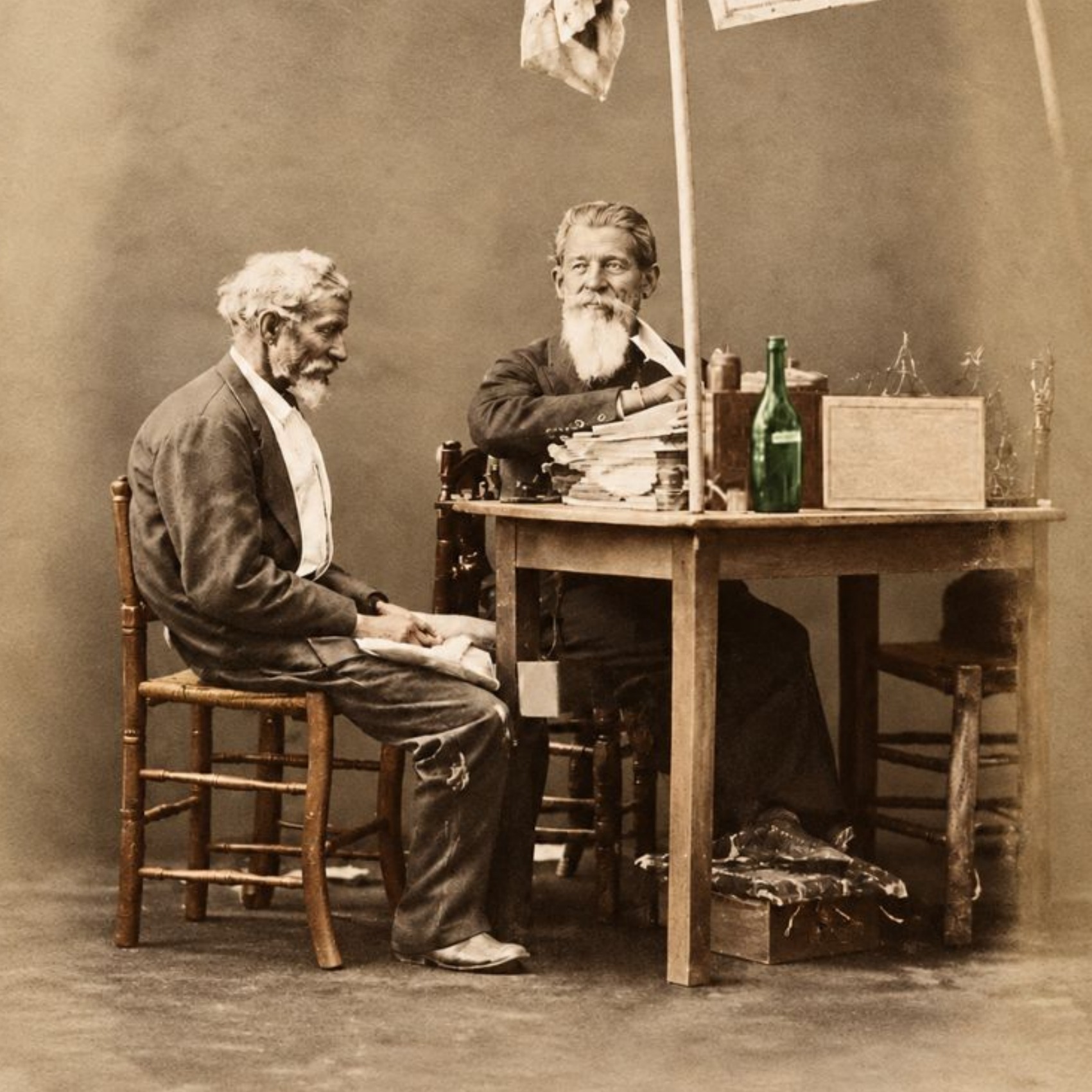 Enlarge image
Mexico, 1870
The photograph “Escribano público con su cliente” (“Public scribe with his client”), by Cruces y Campa, belongs to the series Retratos fotográficos de tipos mexicanos, produced around 1870. It shows a scribe and his client in the former’s workplace, in a staged composition typical of nineteenth-century photographic series depicting social types and occupations.
The scribe sits behind a table with papers and professional tools. A bottle of cider stands out on the table: a secondary detail with considerable documentary value. Its presence shows that cider circulated in Mexico in the nineteenth century and could fit naturally into social and professional settings beyond meals and festivities.
The photograph now belongs to the Cruces y Campa Collection at the Muséu del Pueblu d’Asturies in Xixón. It provides significant visual evidence of cider’s presence in the Americas and of nineteenth-century Atlantic exchanges.
Source/provenance: Colección Cruces y Campa, Muséu del Pueblu d’Asturies (Xixón). Reference: book, pages 6–7.
Back to contents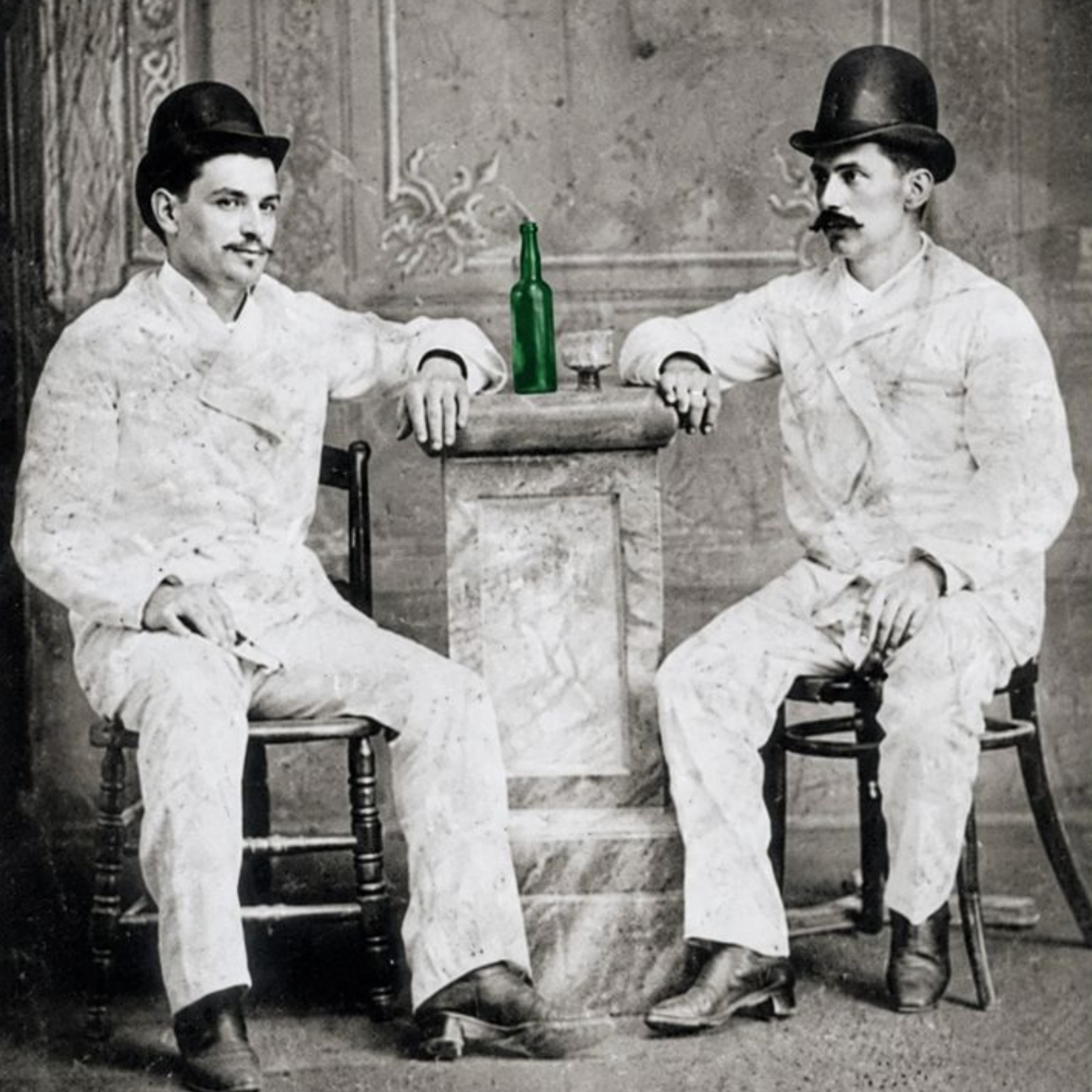 Enlarge image
Cuba, 1885
This tintype portrays two Asturian emigrants in Cuba posing in a photographic studio, wearing light-coloured suits and hats, in a carefully arranged scene clearly prepared for the camera. At the centre, on a pedestal separating the two men, a bottle of cider and a glass stand out.
The bottle’s presence is significant. It is more than decoration: it provides a visible reference to Asturias, personal identity, the social world of Asturian emigration in Cuba and the drinking habits emigrants took across the Atlantic.
The sitters’ relaxed posture, neat clothing and studio setting suggest a portrait intended to be kept, probably to send to relatives and acquaintances in Asturias.
Cider occupies a discreet yet clearly visible place at the centre of the image, asserting its importance. The tintype is therefore a valuable visual record of Asturian cider culture among emigrants in the Americas in the late nineteenth century. The photograph belongs to the Historical Archive of Valle, Ballina y Fernández and helps explain how cider accompanied the Asturian diaspora.
Source/provenance: Historical Archive of Valle, Ballina y Fernández. Reference: book, pages 8–9.
Back to contents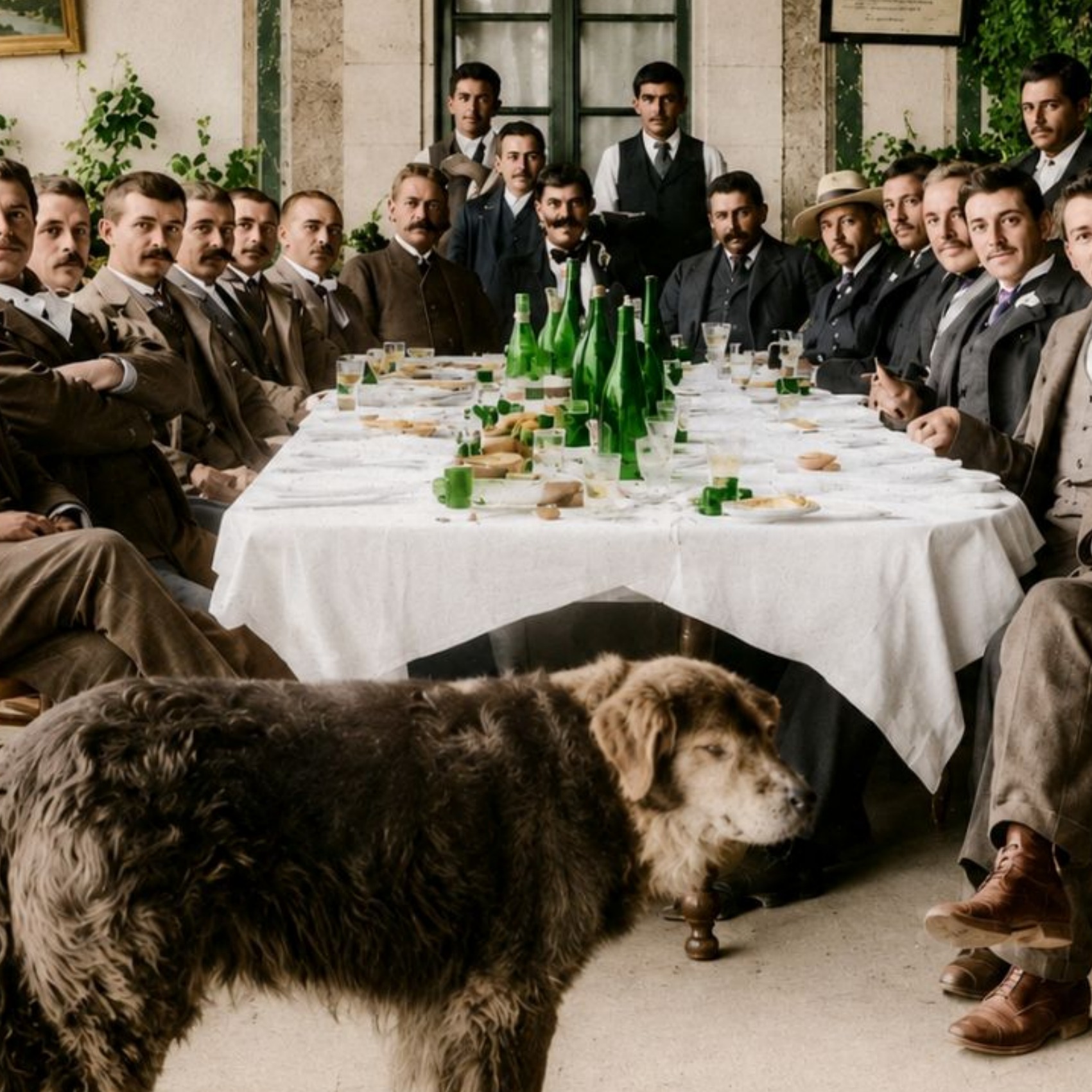 Enlarge image
Mexico*, 1900
Little information is available about this image. The photograph shows a group of Asturian emigrants gathered around a table, in a group portrait dated to around 1900 and catalogued as “Group of Asturian emigrants”.
The photographer is anonymous and the location is probably* Mexico. The group consists mainly of adult men, presenting themselves with dignity and respectability, posing formally in suits and smart clothing. Their arrangement around the table reinforces the scene’s social and communal character.
At the centre is a table covered with a white tablecloth, with plates, glasses and numerous bottles. These elements suggest a shared meal, celebration or other social gathering.
The scene reflects the importance of meetings and shared spaces in the life of the diaspora.
It belongs to the photographic archive of the Muséu del Pueblu d’Asturies.
Its main interest lies in offering a collective picture of Asturian emigration around 1900, even without identifying each individual.
Source/provenance: Fototeca del Muséu del Pueblu d’Asturies. Reference: book, pages 10–11.
Back to contents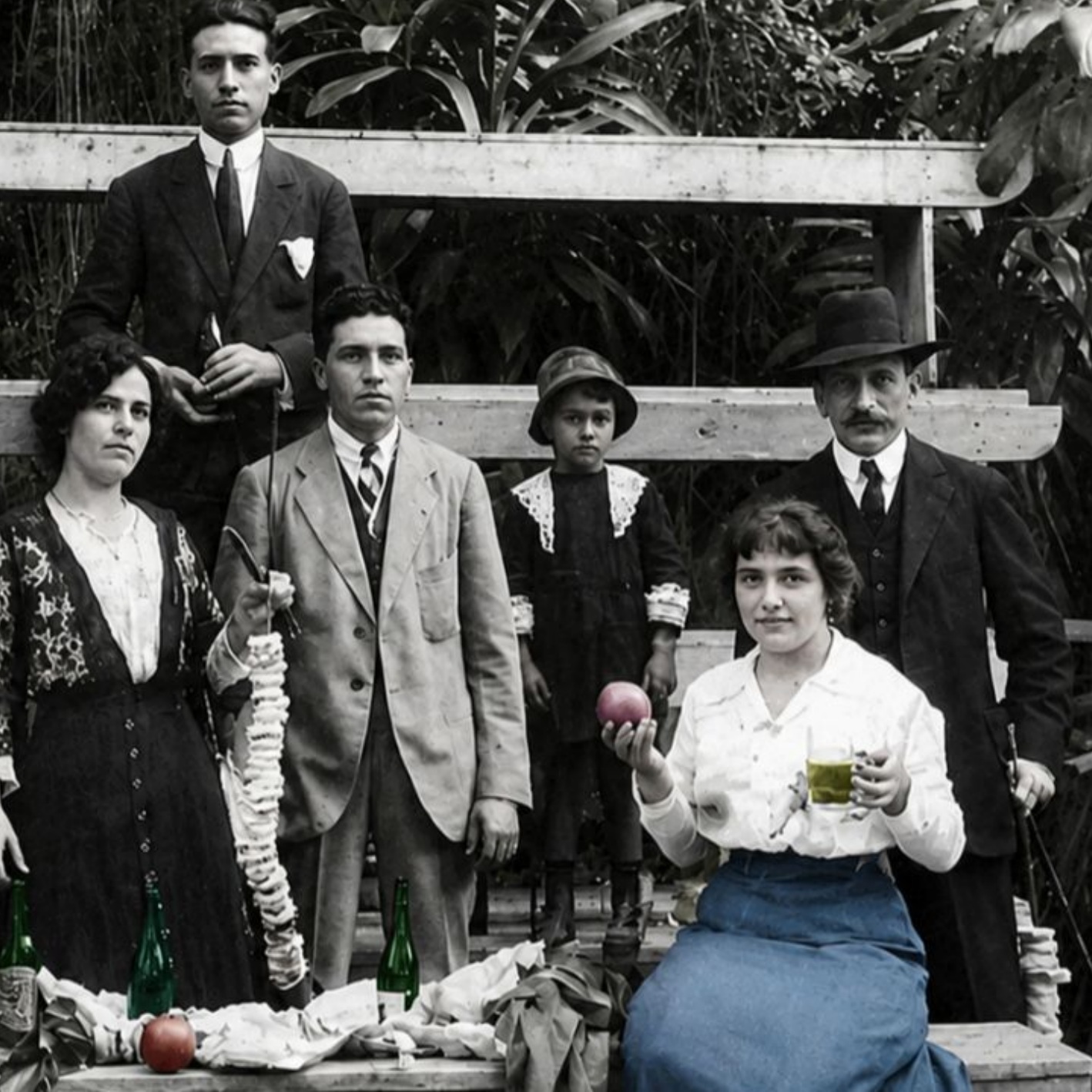 Enlarge image
Havana, 1917
Participants in an outing organised by Juventud de Cuideiru in Havana.
They pose beside a table with aniseed doughnuts, apples and bottles of El Gaitero champagne cider, products that recreated the atmosphere and flavours of Asturian romerías in Cuba.
The scene reflects emigrants’ efforts to preserve customs and forms of social life brought from Asturias.
Cider appears alongside other elements closely associated with Asturian festive culture. Apples evoke the landscape and cider-making tradition, while the doughnuts complete the culinary picture, showing how certain foods and drinks helped recreate Asturias from afar.
The presence of a young girl among the participants suggests how these customs, rooted in homesickness, were passed on to new generations and have survived to the present.
The photograph was taken in Havana by Benito B. Freijeiro, whose studio was at Zequeira, 113, and belongs to the Ana Fleites Gutiérrez Collection.
Source/provenance: Colección Ana Fleites Gutiérrez; photograph by Benito B. Freijeiro, La Habana, 1917. Reference: book, pages 12–13.
Back to contents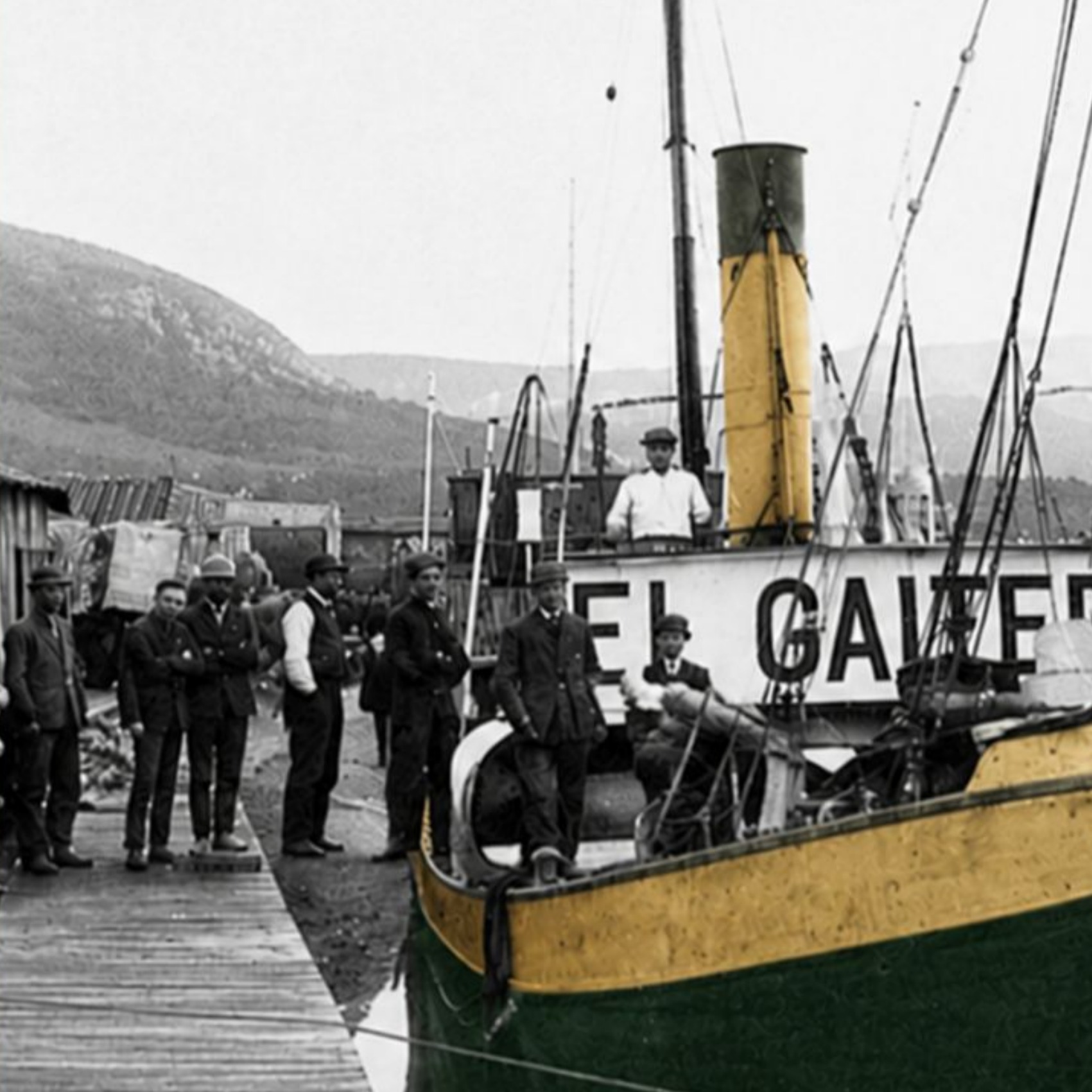 Enlarge image
Villaviciosa, 1920
Strong demand for cider among Asturian emigrant communities in the Americas helped consolidate transatlantic exchanges and overseas trade.
Here we see El Gaitero cider being loaded at La Espuncia quay in Villaviciosa around 1920. Cider-house workers and transport staff wait beside the ship on the estuary quay as the goods are prepared for departure.
The scene documents a key stage in sending Asturian cider to American markets: loading the cargo.
The location of El Gaitero’s factory was vital to the development of trade with the Americas. The proximity of the cider house, port and shipping routes removed the difficulties of overland transport in Asturias.
The photograph is by A. del Fresno and dates from 1920.
It belongs to the Historical Collection of Valle, Ballina y Fernández, S.A. (Sidra El Gaitero), in Villaviciosa.
Source/provenance: Historical Collection of Valle, Ballina y Fernández, S.A. (Sidra El Gaitero), Villaviciosa; photograph by A. del Fresno, 1920. Reference: book, pages 14–15.
Back to contents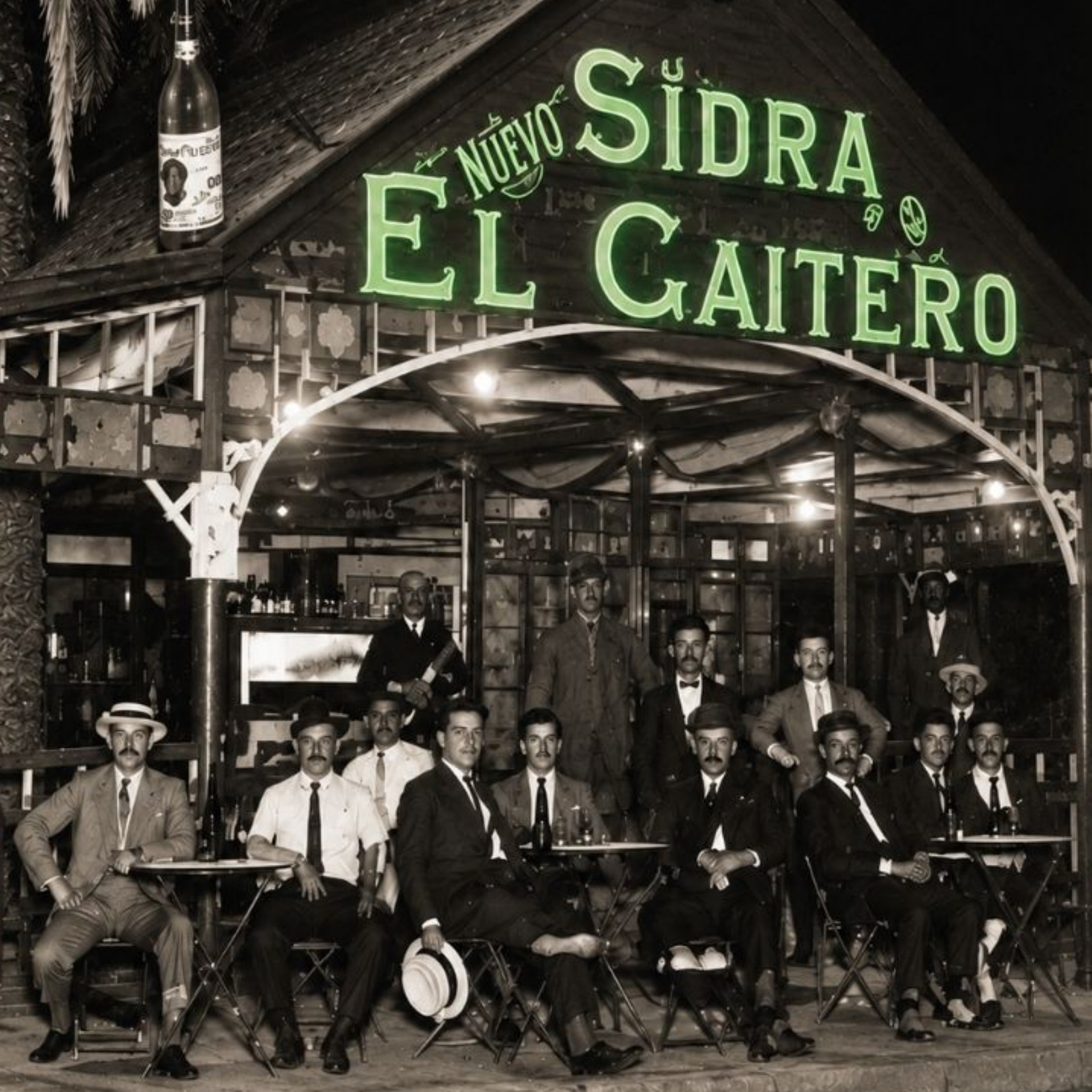 Enlarge image
Buenos Aires, 1922
The image shows a drinks kiosk in Buenos Aires in 1922, in an urban setting shaped by the strong presence of European emigration in general and Asturian emigration in particular.
A large El Gaitero cider advertisement stands out on the front of the kiosk, clearly visible above its structure.
The brand is integrated into an everyday, popular place of consumption, showing how firmly Asturian cider had become part of commercial life in the Argentine capital.
El Gaitero became a recognisable point of reference for thousands of Asturians and their descendants who settled in the Americas. The advertisement clearly illustrates the consolidation of a commercial network designed for this emigrant market.
Cider accompanied celebrations, family gatherings and the social life of the Asturian community. Yet its presence extended beyond Asturian centres and emigrant circles. The kiosk’s prominent advertising shows that the product sought a place in the city’s wider drinks market.
The image belongs to the Historical Archive of Valle, Ballina y Fernández.
Source/provenance: Historical Archive of Valle, Ballina y Fernández. Reference: book, pages 16–17.
Back to contents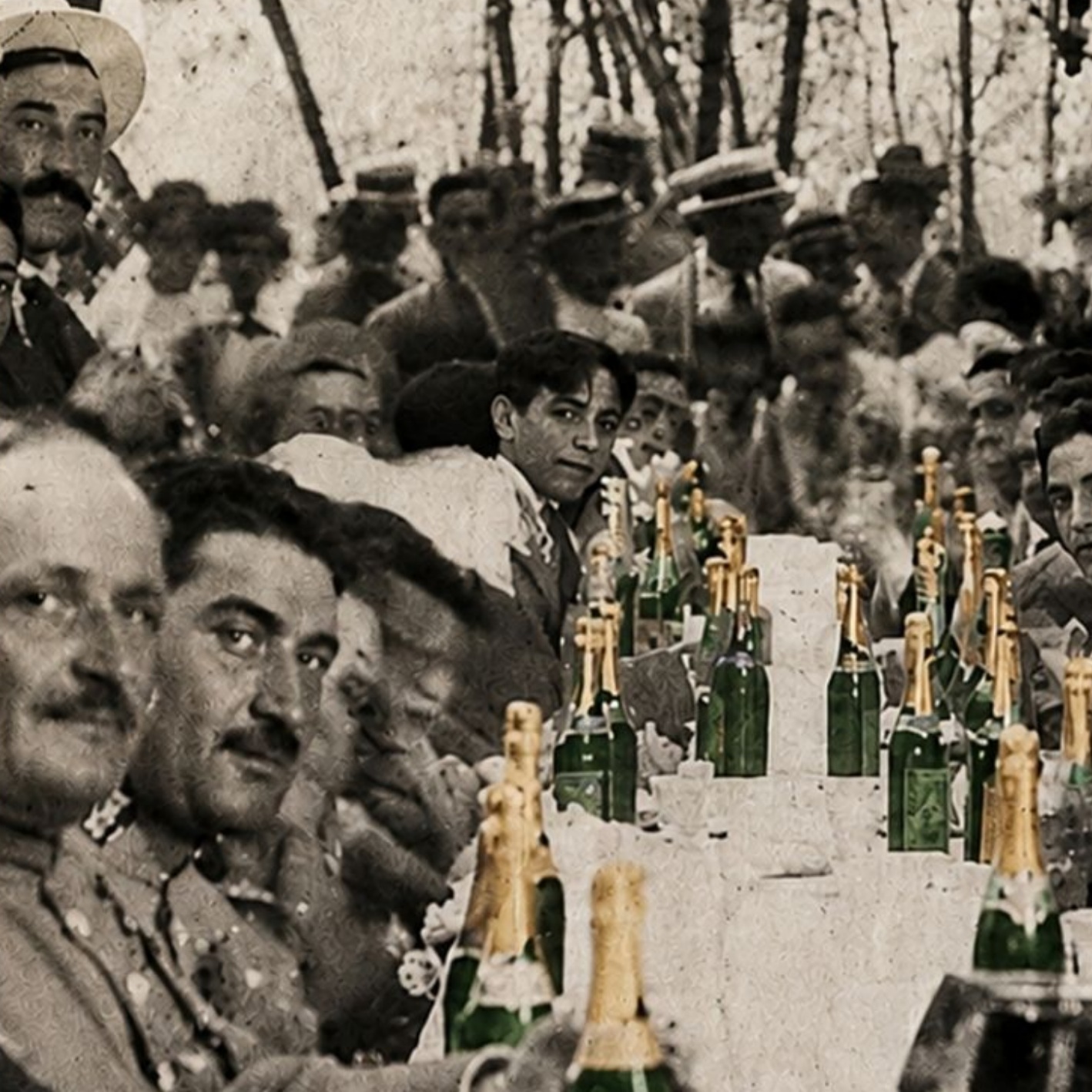 Enlarge image
Havana, 1924
Cuba was one of the main destinations for emigrants from Salas from the late nineteenth to the early twentieth century.
The photograph records a Círculo Salense banquet at “La Polar” in Havana in 1924, around a long table with numerous bottles of cider visible among the guests.
Founded in 1914, the Círculo Salense of Havana brought together people from the municipality of Salas and their descendants. Its role went beyond social gatherings and festivities: it maintained a support network among people connected by the same municipality of origin.
The Círculo took part in various material and educational initiatives linked to Salas.
The association enjoyed a long history of continuity, celebrating 105 years of associative life in 2018 and receiving the Gold Medal of Asturias.
Its 2020 members’ assembly still drew dozens of participants, evidence of a connection with both Asturias and Salas maintained for more than a century.
Book, pages 18–19. Provenance and documentary details are included in the reproduced text.
Back to contents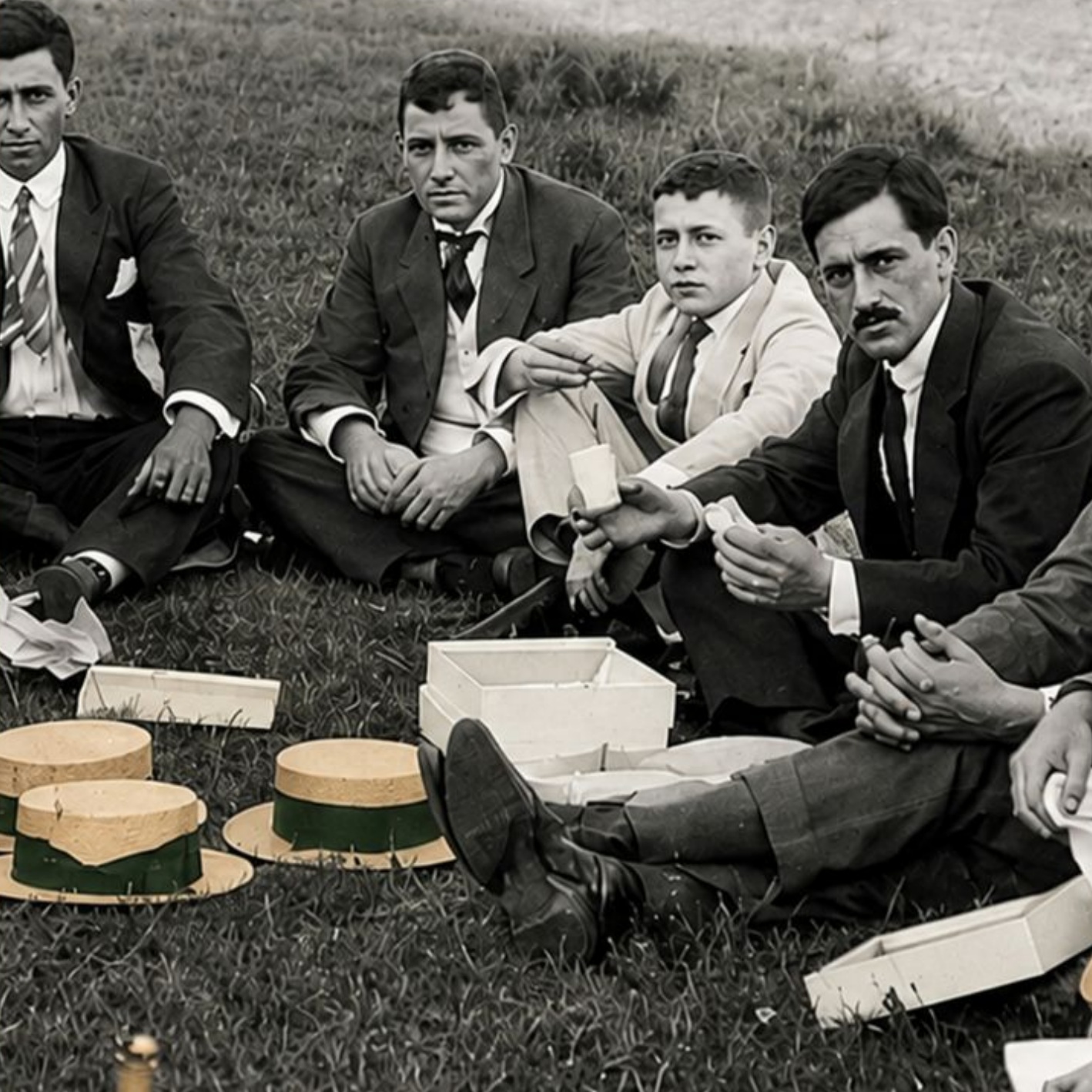 Enlarge image
Cuba, 1925
The photograph shows a group of emigrants gathered in a meadow in a scene of shared social life.
The men pose informally, seated on the grass among crates, hats and bottles of cider, in a setting quite different from the studio portraits more usual at the time.
The scene reflects the lively associational life developed by Asturians in Cuba during the early decades of the twentieth century. Large Asturian organisations coexisted with associations based on members’ municipality, parish or village of origin. In the case of Avilés, the existence of the Círculo Avilesino of Havana is documented from at least the 1910s.
Newspapers in 1924 reported solidarity between people from Avilés living in Asturias and those settled in Cuba, who continued to remember and support their “native corner”. The Círculo Avilesino even sent prizes for schoolchildren in the municipality of Avilés, showing that connections with the homeland were practical, sustained and supportive.
Asturian identity thus coexisted with strong local ties: emigrants continued to identify as people from Avilés, Villaviciosa, Cuideiru or other municipalities, as well as Asturians.
Book, pages 20–21. Provenance and documentary details are included in the reproduced text.
Back to contents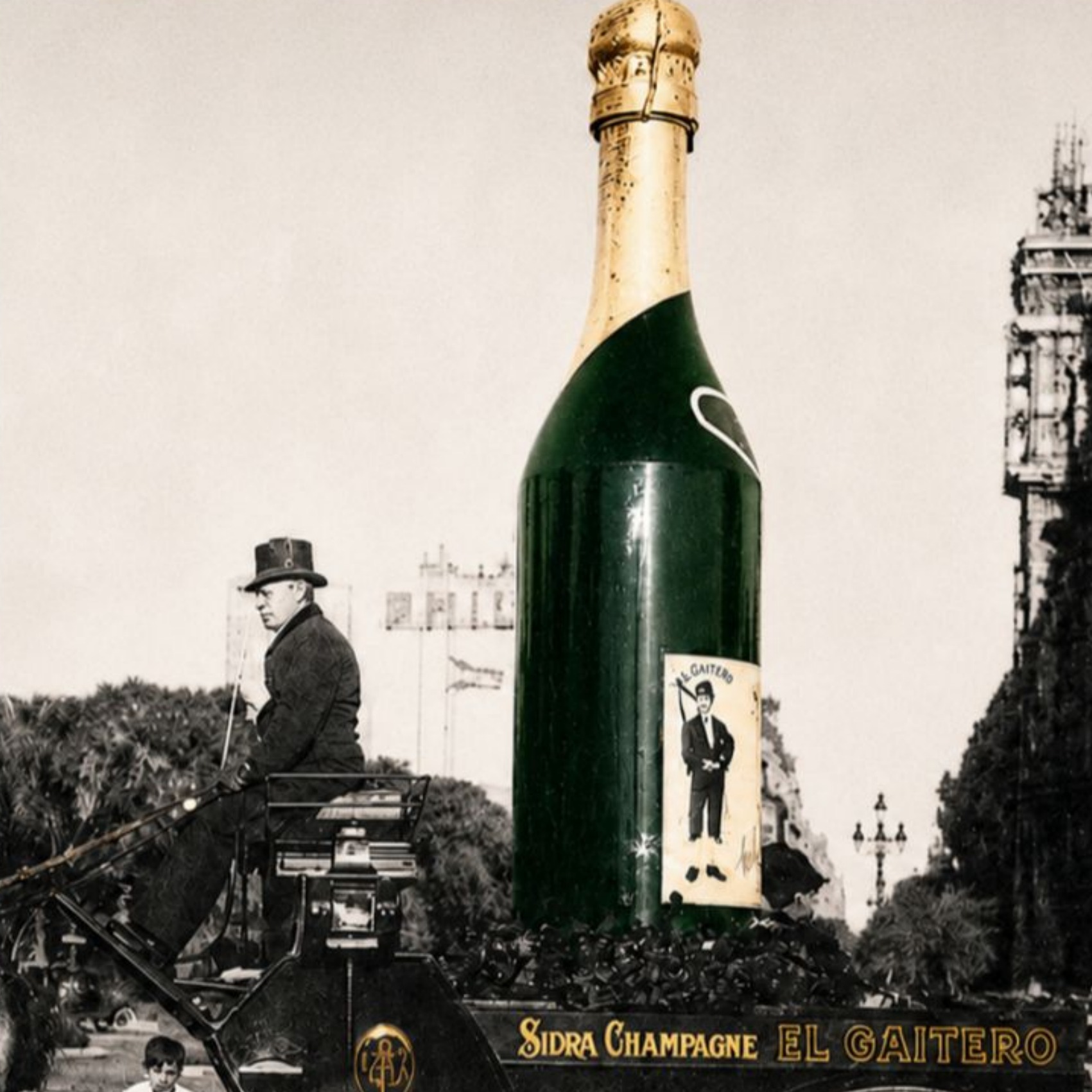 Enlarge image
Buenos Aires, 1925
The image shows an unusual Sidra El Gaitero advertising carriage in Buenos Aires around 1925.
An oversized bottle on the vehicle forms the centrepiece of the promotion. The brand name Sidra Champagne El Gaitero can be read on its side.
The scene clearly documents Asturian cider’s commercial presence in the Argentine capital. The use of a vehicle intended to be seen by the whole population, beyond Asturian emigrants, shows that cider sought a public, recognisable presence beyond emigrants’ private consumption.
The photograph illustrates the extent of El Gaitero’s commercial strategy for the American market and the level of investment devoted to promotion.
The carriage is therefore evidence of the economic and cultural connection between Asturias and Buenos Aires.
Dated 1925, the photograph is held in the Biblioteca Digital Maliaya.
Source/provenance: Biblioteca Digital Maliaya; Buenos Aires, 1925. Reference: book, pages 22–23.
Back to contents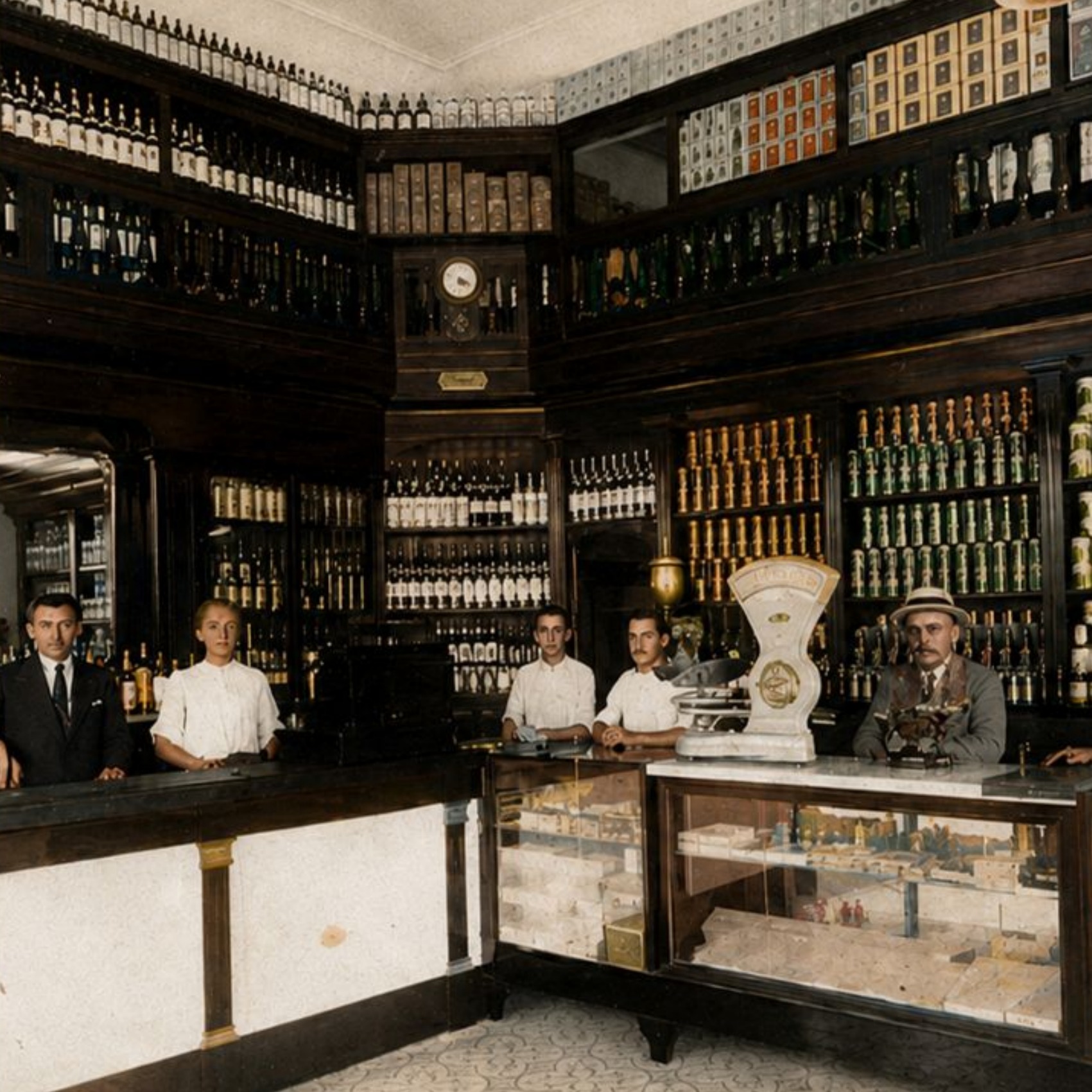 Enlarge image
Havana, 1925
The photograph shows the interior of La Favorita shop in the Vedado district of Havana around 1925.
The business was run by Asturian immigrants, including Joaquín and Pepe. Several managers and workers pose behind the counters. The shelves are filled with a wide variety of bottles, boxes and other products.
The drinks sold by the shop included Asturian ciders such as Zarracina and El Gaitero.
The scene documents the presence of Asturian products in Havana’s trade during the first third of the twentieth century. It also shows Asturian emigrants’ role in distributing and selling these products in Cuba.
The photograph is by Foto Diago, is printed on paper and is held in the photographic archive of the Muséu del Pueblu d’Asturies in Xixón.
It is direct evidence of the connection between Asturian emigration, commerce and cider’s presence in Havana.
Source/provenance: Fototeca del Muséu del Pueblu d’Asturies (Xixón); photograph by Foto Diago. Reference: book, pages 24–25.
Back to contents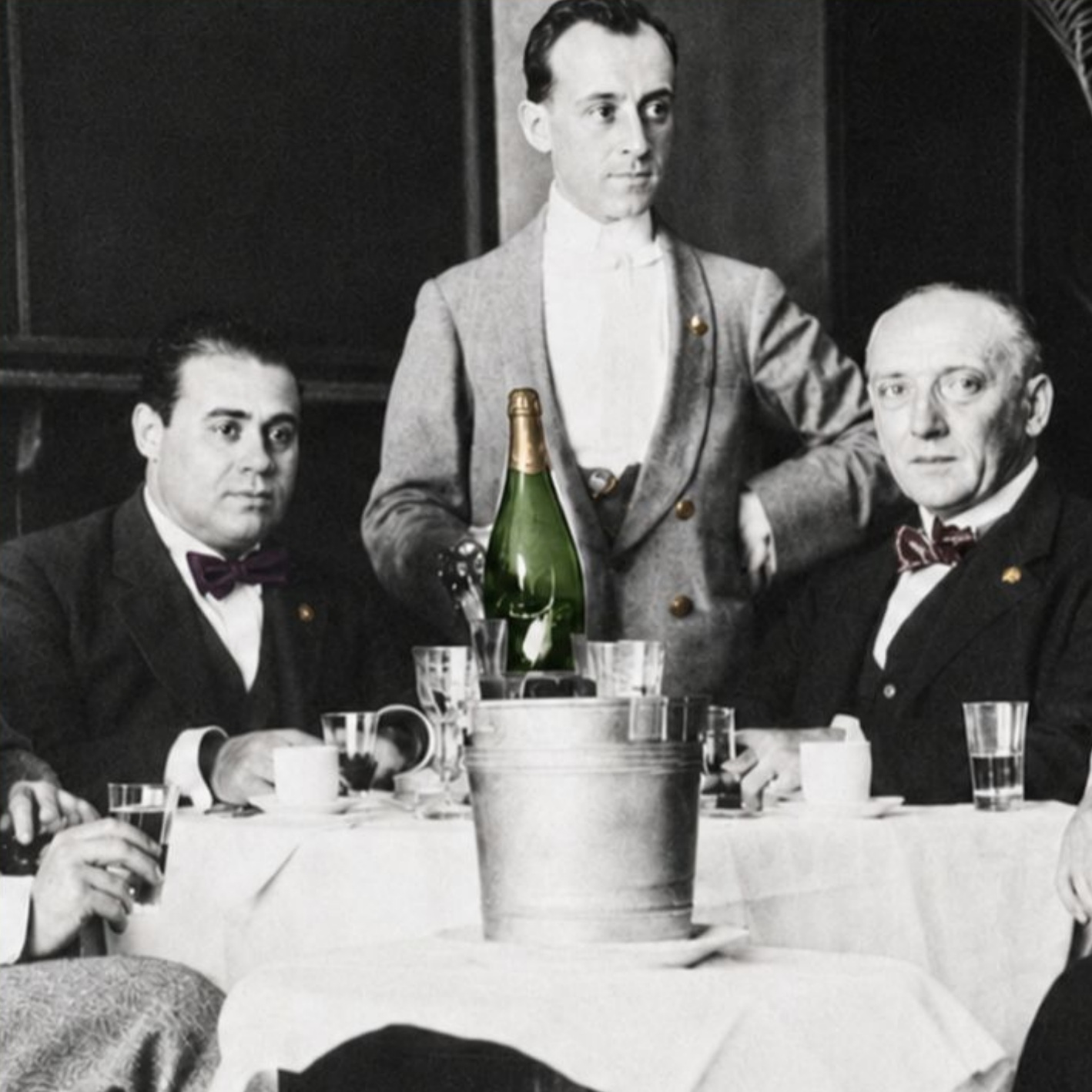 Enlarge image
Buenos Aires, 1925
Taken in the dining room of the Club Español in Buenos Aires, the photograph shows cider in a formal, exclusive setting.
Whereas it appeared as an everyday drink shared at romerías and family gatherings, here it occupies a space of social representation.
The bottle stands at the centre of the table, cooling in an ice bucket and being served by a waiter in a prestigious club.
The Club Español of Buenos Aires was a highly regarded institution within the Spanish community.
Opened in 1911, its headquarters were conceived as a meeting place for upper-class cultural and social life. The building had reception rooms, recreational spaces and a fine restaurant, where the photograph was taken.
This illustrates the breadth of cider consumption among emigrant communities, similar to that in Asturias: the same drink could appear at a countryside romería or in an elegant Buenos Aires dining room, spanning intimate, popular, institutional and exclusive settings.
The photographer is anonymous and the image dates from 1925.
Book, pages 26–27. Provenance and documentary details are included in the reproduced text.
Back to contents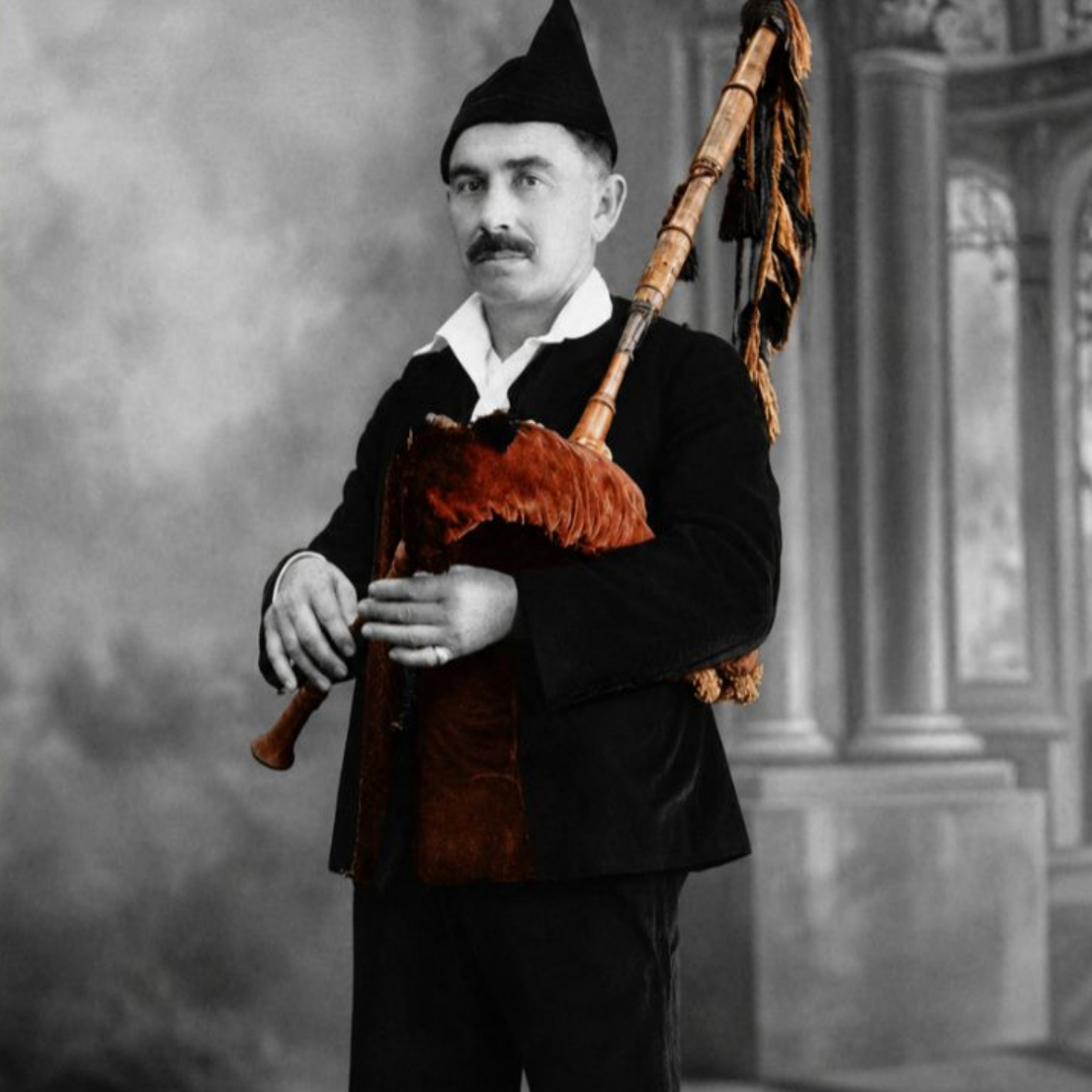 Enlarge image
Havana, 1929
The photograph records bagpiper Francisco Martínez Martínez, “Pancho”, promoting Sidra El Gaitero during a visit to Havana in 1929.
Pancho’s extended promotional tour shows the company’s commitment to American audiences and underlines that cider did not travel alone: representatives, commercial strategies and a brand image intended to be recognised by the Cuban public travelled with it.
The image is particularly significant in the history of cider and Asturian emigration because of the symbolism this bagpiper acquired as a brand figure. He linked cider to traditional Asturian culture while also bearing witness to the commercial activity surrounding cider in Cuba. Havana was a major historic destination for Asturian emigrants, and El Gaitero’s presence in these American markets formed part of that transatlantic economic and cultural connection.
Dated 1929, the photograph comes from the Historical Archive of the Fundación José Cardín Fernández and is held in the Biblioteca Digital Maliaya.
Source/provenance: Historical Archive of the Fundación José Cardín Fernández; held in the Biblioteca Digital Maliaya. Reference: book, pages 28–29.
Back to contents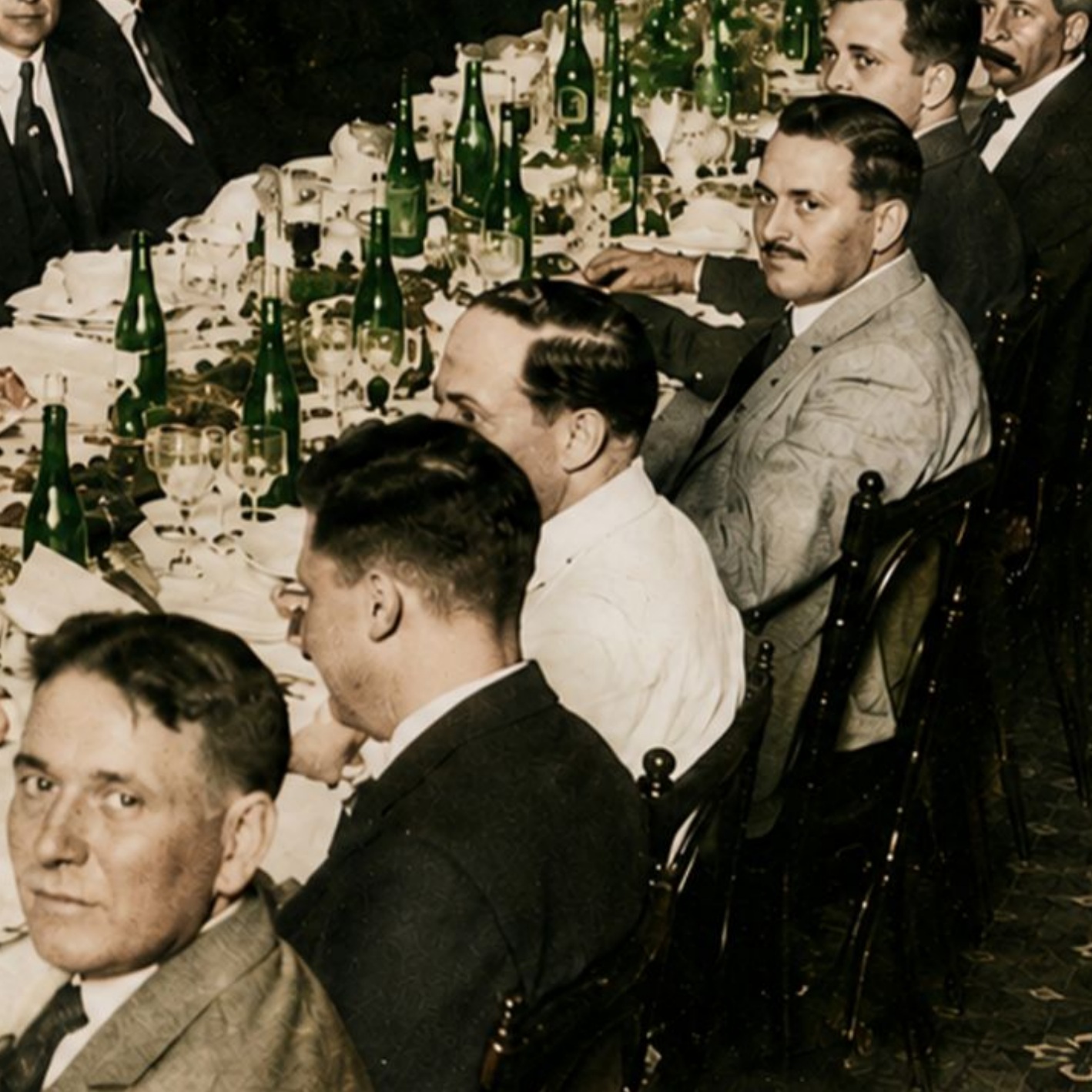 Enlarge image
Argentina, 1930
A meal held at the Hotel América in Córdoba, Argentina, around 1930.
A large group of upper-class Asturians living in the country gathers around a long table.
The scene shows a moment of shared social life within the Asturian emigrant community. Among those present is Dr Carlos Federico Fernández Llano, known for his interest in and connection with gastronomy.
Plates, glasses and a large number of bottles can be seen on the table.
The gathering reflects the importance of collective occasions among Asturians settled in the Americas.
At these celebrations, food and drink, specifically cider, were a natural part of social interaction, helping maintain identity and personal and cultural ties among emigrants.
The photographer is anonymous and the document belongs to the El Progreso de Asturias Collection.
The image is held in the Muséu del Pueblu d’Asturies in Xixón.
Source/provenance: Colección El Progreso de Asturias, Muséu del Pueblu d’Asturies (Xixón); anonymous photographer. Reference: book, pages 30–31.
Back to contents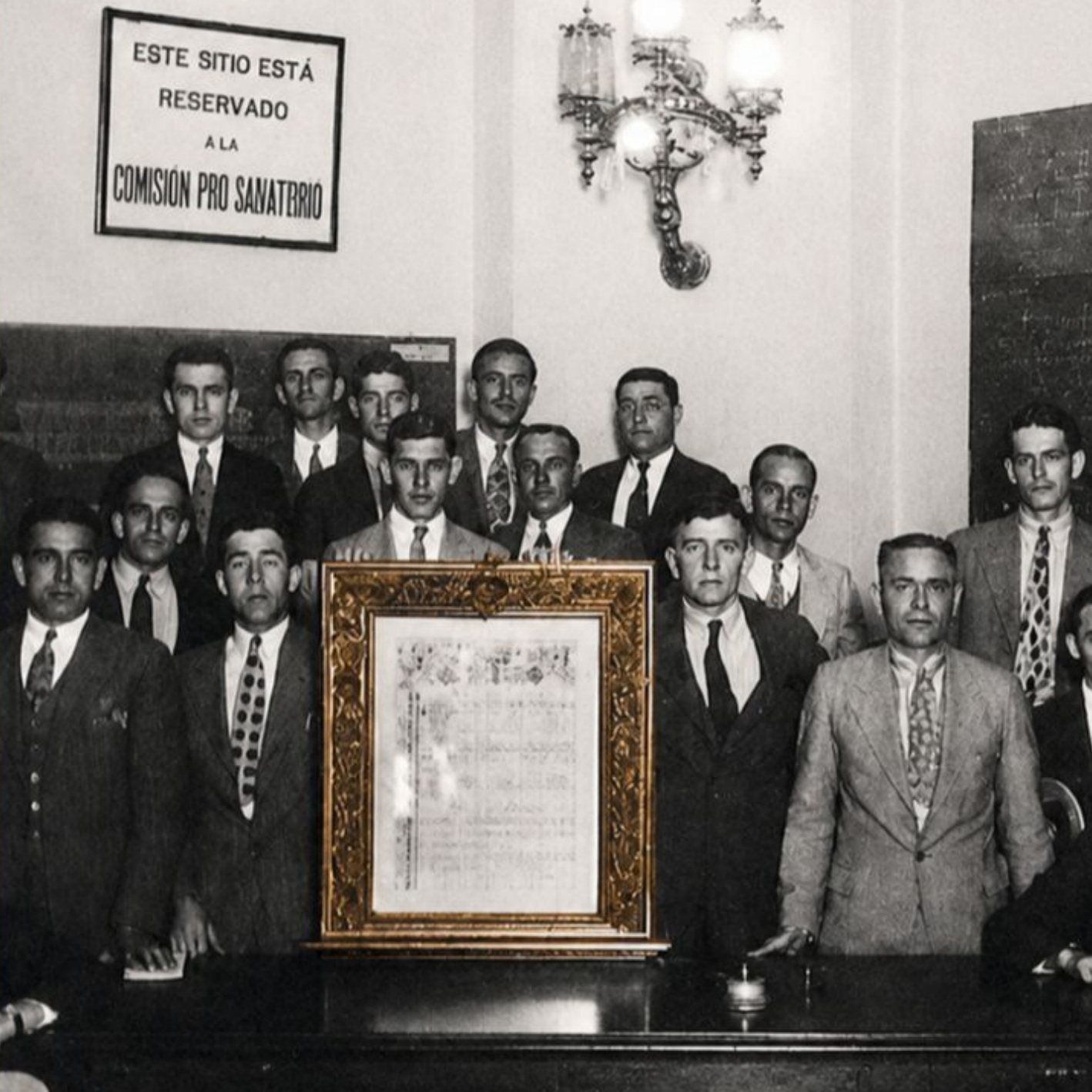 Enlarge image
Havana, 1932
The presentation of honorary membership of the Sociedad de Naturales del Concejo de Villaviciosa to Valle, Ballina y Fernández, held in Havana in 1932.
Representatives of the company and the emigrants’ society pose around the framed diploma recording the distinction.
The portrait reflects the close relationship the firm maintained with Asturian associations established in the Americas. These organisations played a fundamental role in emigrant communities’ social and cultural life.
Valle, Ballina y Fernández supplied cider free of charge for celebrations organised by these societies, including particularly significant festivities such as 8 September.
For these occasions the company donated cases of champagne cider or barrels of cider, ensuring that, as in Asturias, cider was present at every important moment.
The award of honorary membership in 1932 expressed gratitude for this sustained collaboration and testified to a relationship extending beyond commerce.
The document is anonymous and dates from 1932.
Book, pages 32–33. Provenance and documentary details are included in the reproduced text.
Back to contents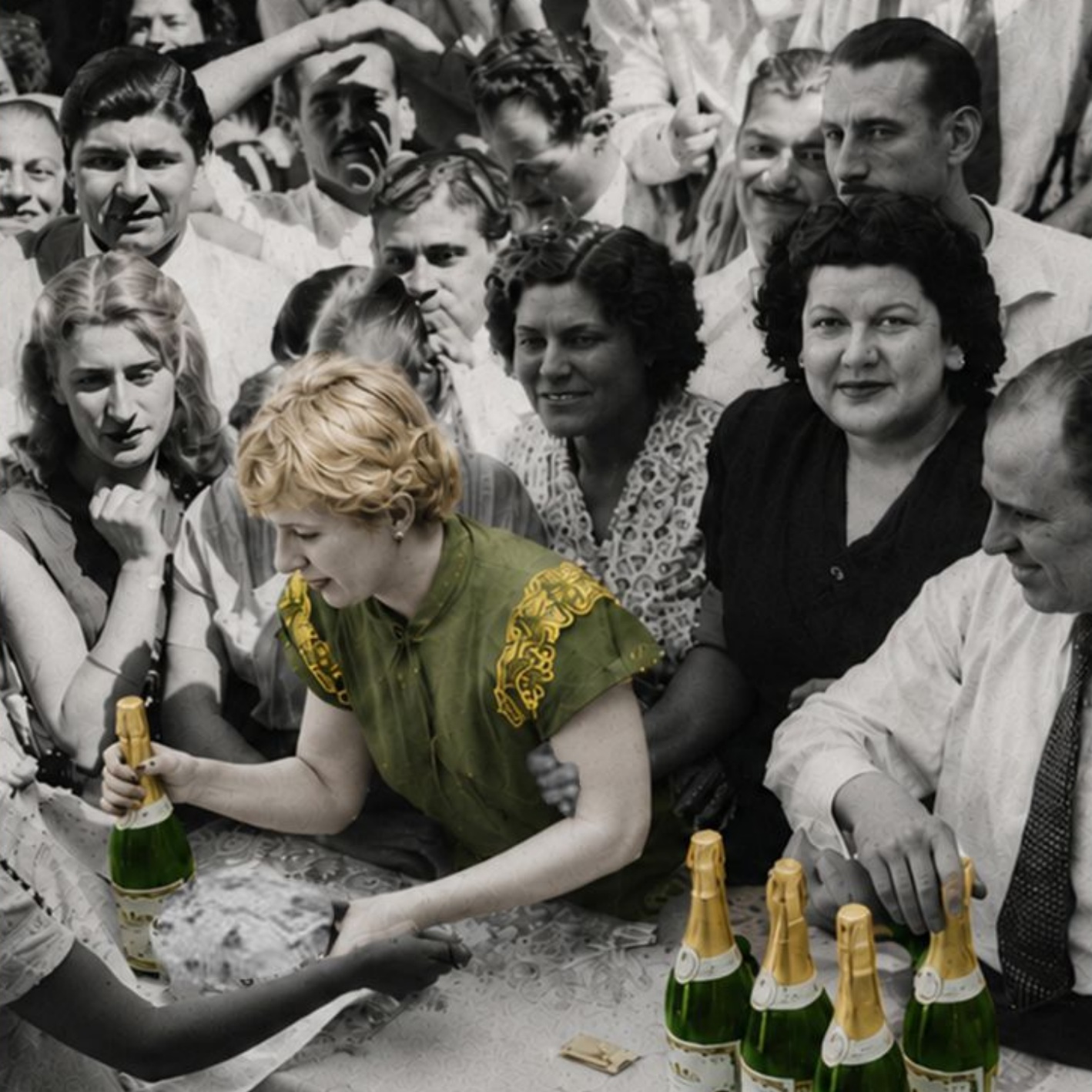 Enlarge image
Argentina, 1947
Juan Domingo Perón and Eva Perón are shown at Christmas in 1947, in a context where cider and pan dulce acquired strong social and symbolic significance in Argentina.
In 1950, Eva Perón described how millions of families received cider and pan dulce at Christmas, presented by the government as symbols of its closeness to the working classes. Early Peronism promoted distribution of these products among ordinary people, a practice that continued on a large scale in subsequent years.
Alongside pan dulce, of Italian origin, Asturian cider became a characteristic element of Argentine Christmas celebrations.
Two traditions from different migration flows thus came to share the table in a society largely built by immigration.
After the September 1955 coup that overthrew Perón, the Fundación Eva Perón was placed under state intervention and subsequently liquidated by the new regime.
The image was shared by Perón, el legado (@LegadoPeron).
Source/provenance: image shared by Perón, el legado (@LegadoPeron). Reference: book, pages 34–35.
Back to contents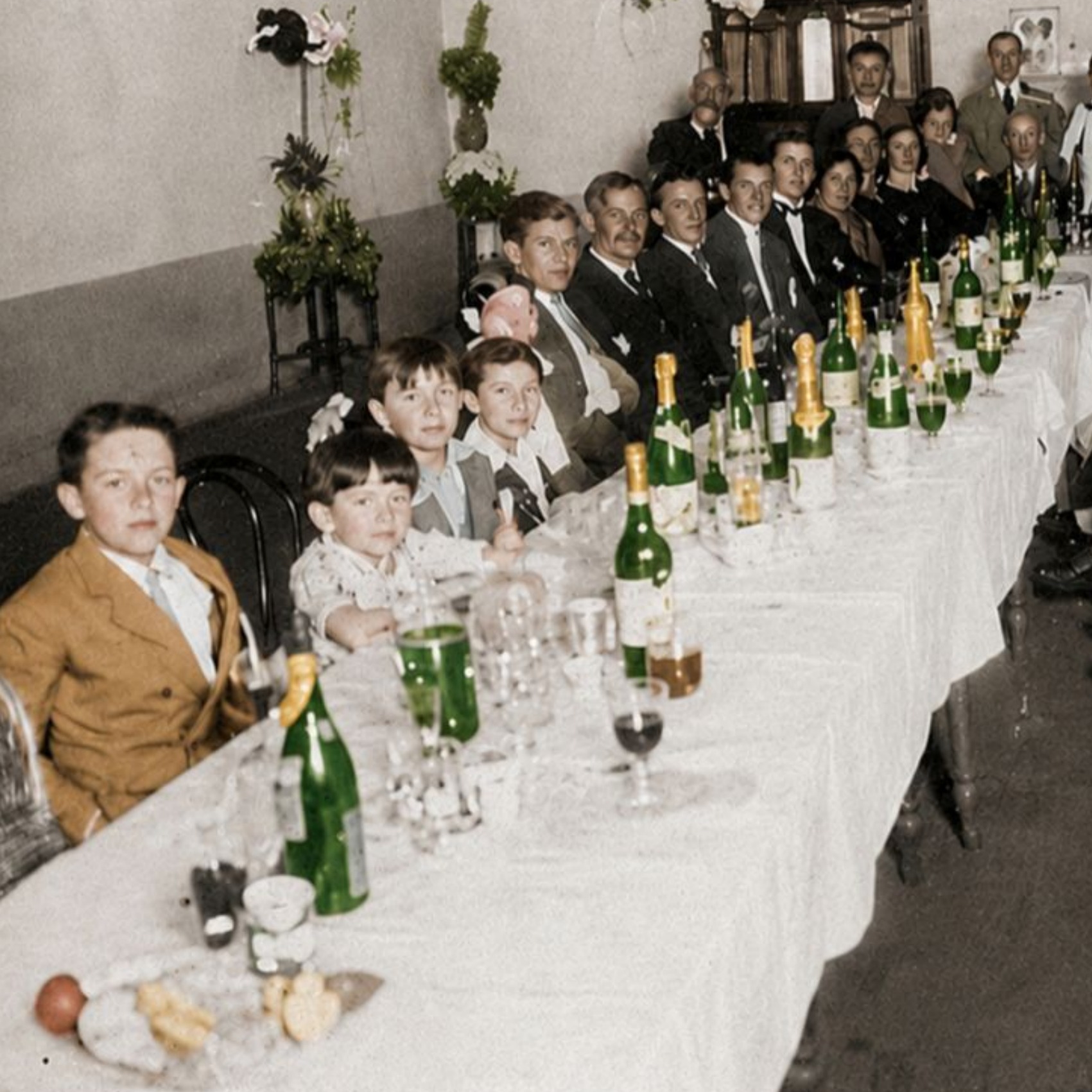 Enlarge image
Buenos Aires
This photograph shows a large gathering in Buenos Aires, on an unknown date, around a long table where cider is being consumed.
Unlike many photographs of emigration, featuring almost exclusively adult men, this image includes a noticeable presence of women and children.
This family composition gives the image particular interest: it shows emigration as an established community of families, beyond a male network of work and associations. Photography may have been less common at such informal gatherings.
The children’s presence also indicates the participation in these social spaces of a new generation born or raised in the host country.
The photograph helps explain how customs and products brought from Asturias could be passed on within the family.
In this setting, cider functioned as both a drink and a recognisable element of the culture of origin.
The document belongs to the Miscellaneous Collection (FF) of the Muséu del Pueblu d’Asturies.
Source/provenance: Colección Miscelánea (FF), Muséu del Pueblu d’Asturies. Reference: book, pages 36–37.
Back to contents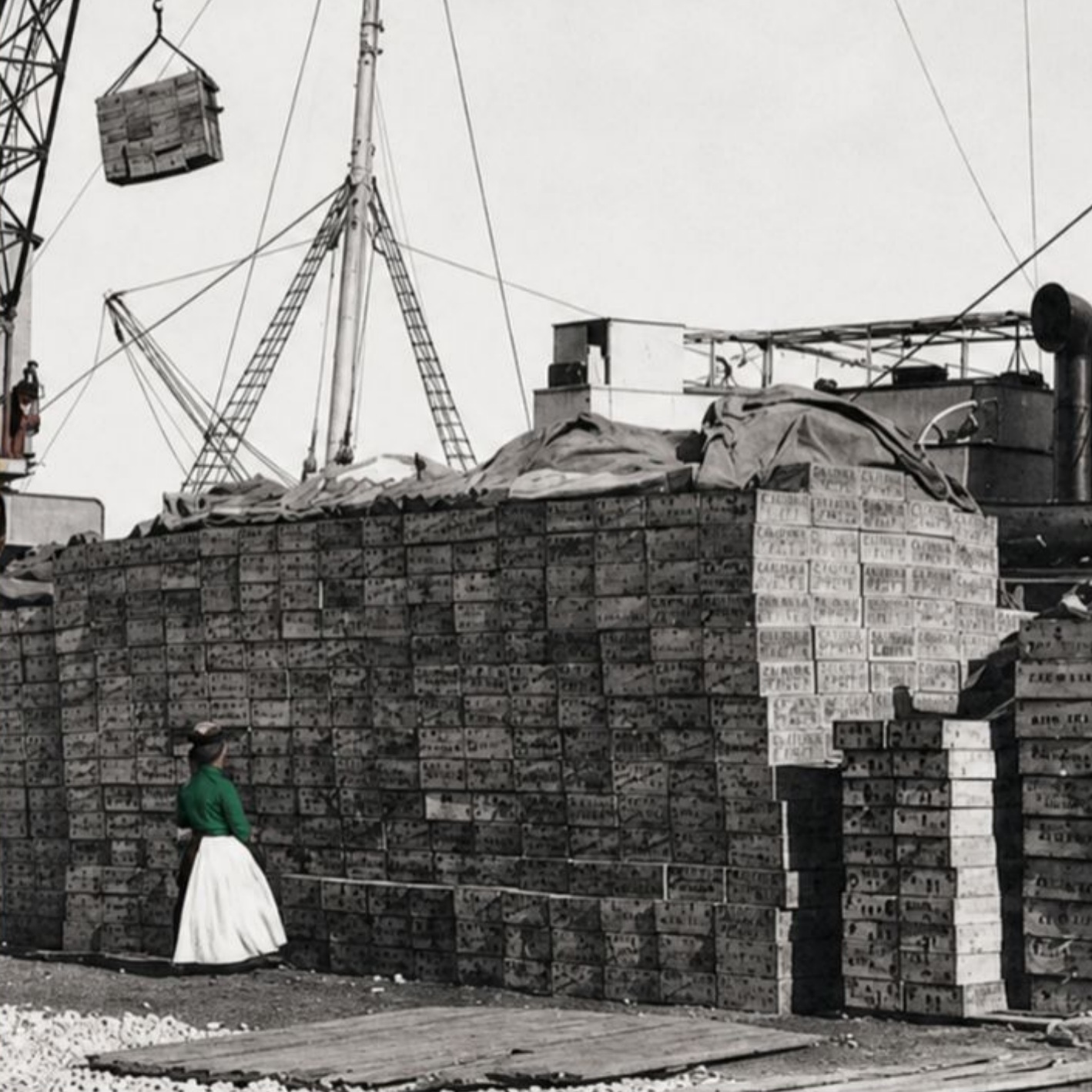 Enlarge image
The importance of exports
From the late nineteenth century, demand from emigrant communities strongly stimulated sparkling cider production. Between 1880 and 1900, at least eight new champagne-style cider companies emerged in Asturias, aimed mainly at the American market.
By the end of the century, more than 98% of sparkling cider production was destined for the Americas. By 1900, Valle, Ballina y Fernández had exported over seven million bottles. In that same year, Industrias Cima produced around 1.4 million bottles and had 72 permanent workers.
Total Asturian natural cider production then stood at around 18 to 25 million litres annually. Volumes continued to grow: some 26 million litres in 1921 and 30 million in 1930.
This trade required modernisation of cider houses, warehouses, bottling, crates and transport.
Valle, Ballina y Fernández came to own steamships, barges, its own dock and cellars with capacity for millions of litres.
Although cider did not have the economic weight of coal or steel, it established a modern, export-oriented food and drink industry.
It also stimulated apple orchards, cooperage, glass, packaging, transport and trade.
Reference sources: Joaquín Ocampo Suárez-Valdés, «Del árbol a la botella: sidra “El Gaitero”, la internacionalización de una empresa familiar», Revista de Historia Industrial, no. 57 (2015), Universidad de Oviedo — read study. For historical figures on Industrias Cima, Rafael Fuertes Arias, Asturias industrial (1902) — record in the Biblioteca Virtual del Principado de Asturias. Book reference: pages 38–39.
Back to contents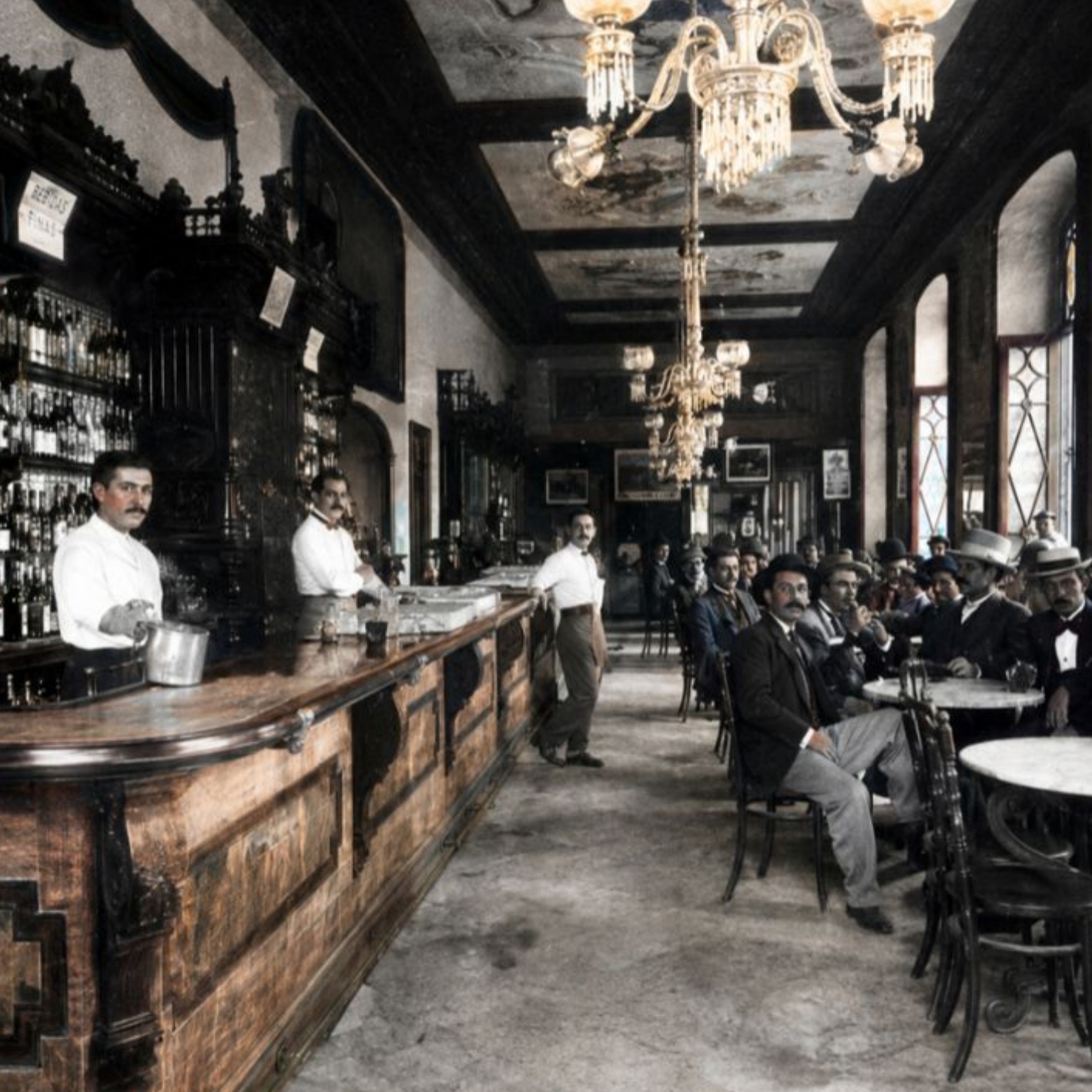 Enlarge image
Cider in cafés
Cider’s presence in Spanish American cafés grew alongside Asturian emigration. From the late nineteenth century, Asturian sparkling cider gained market share in various American countries.
Cuba, Argentina and Mexico were important destinations for these exports.
Producers such as Zarracina, José Cima and Valle, Ballina y Fernández played a prominent role in this commercial expansion.
Cider reached beyond Asturian centres, romerías and family gatherings to cafés, bars, hotels and restaurants in major cities.
Its public presence helped make Asturias and its cider recognisable beyond the emigrant community itself.
Gradually, it became more than a drink associated with the diaspora’s homesickness, competing as an everyday product on American tables and shelves.
Cafés thus became a decisive showcase for Asturian cider’s international reach.
Book, pages 40–41. Provenance and documentary details are included in the reproduced text.
Back to contents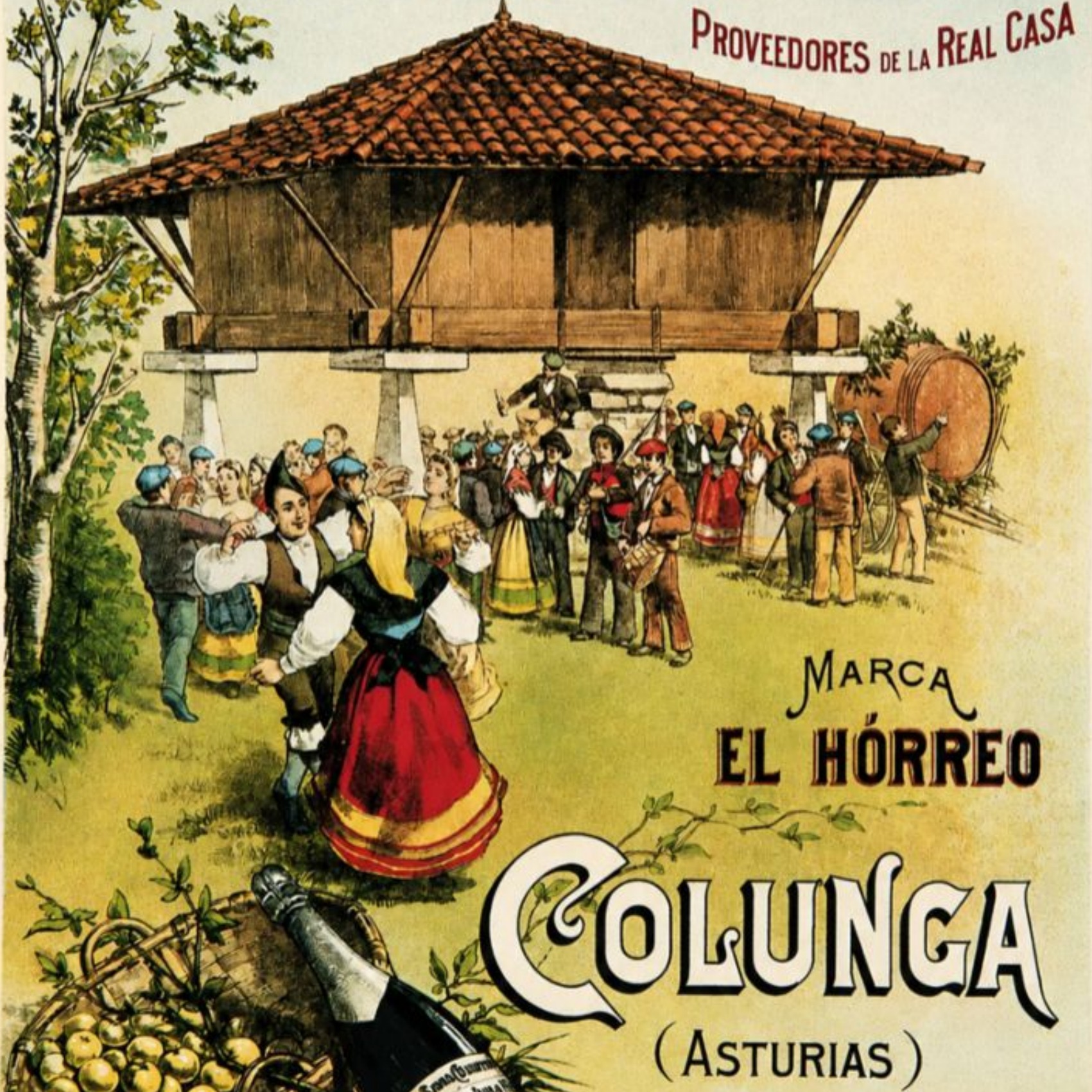 Enlarge image
Advertising poster
This advertisement exemplifies how Asturian cider houses drew on emigrants’ homesickness to sell cider abroad.
The scene brings together several easily recognisable Asturian symbols: the hórreo granary, the romería, dancing, bagpipes, the apple and the cider bottle itself. It sells an idealised image of the land the emigrant left behind alongside the drink.
The composition seeks to awaken emotional memory: drinking cider means symbolically returning to Asturias for a moment.
The product is presented as inseparable from the landscape, festivities and traditional forms of social life of its homeland.
Even the brand name El Hórreo deliberately reinforces that immediate identification with Asturias.
The slogan «Exportación á todas partes» (“Exports everywhere”) is particularly significant, summing up a commercial strategy in which cider followed the same routes as emigration.
Cider thus became both an export product and a vehicle for memory, identity and belonging among overseas Asturian communities.
Book, pages 42–43. Provenance and documentary details are included in the reproduced text.
Back to contents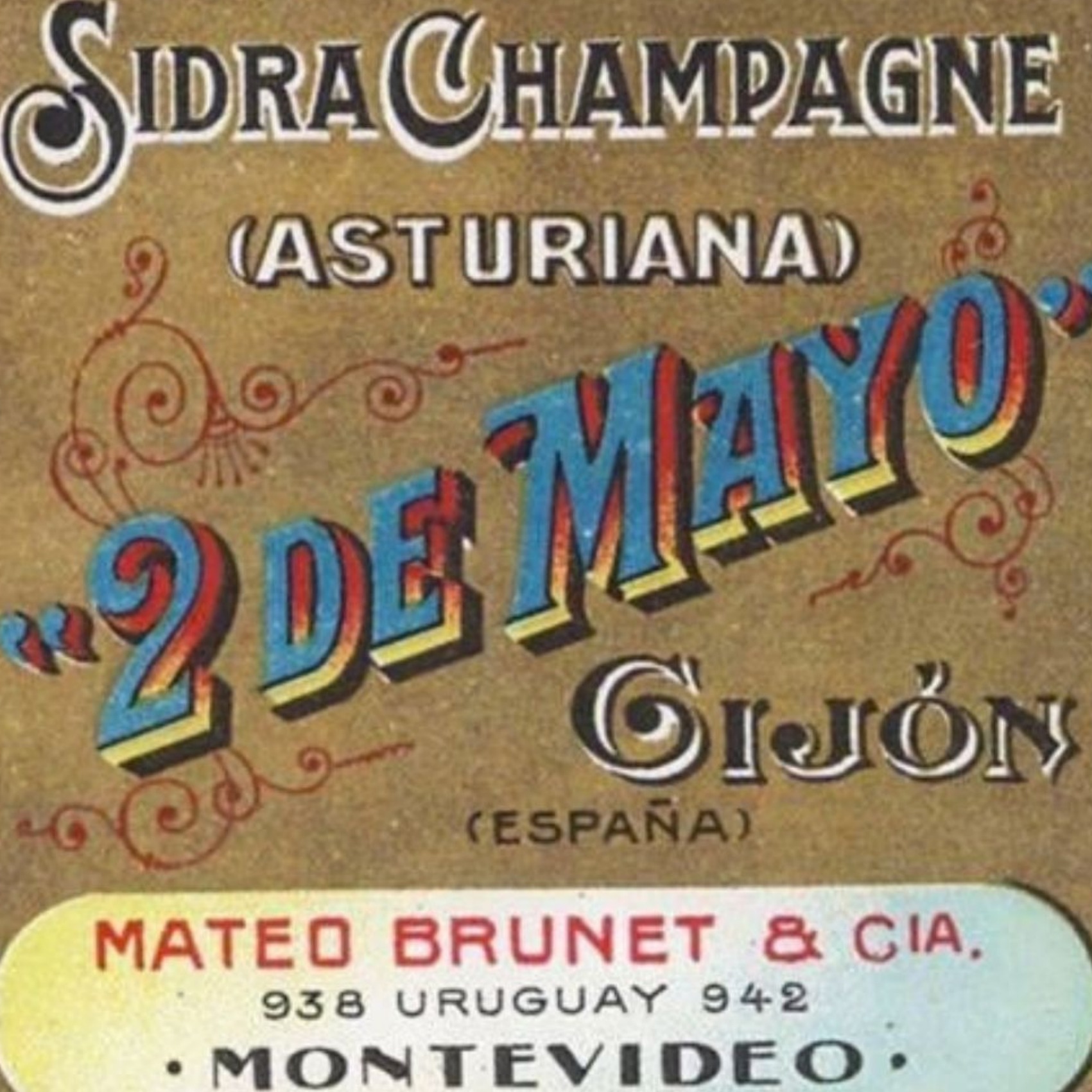 Enlarge image
International labelling
The label for Sidra Champagne “2 de Mayo”, made in Xixón, belongs to a commercial tradition closely connected to Asturian emigration in the Americas.
From the late nineteenth century, emigrants became a fundamental market for Asturian cider.
This involved more than exporting the same bottles sold in Asturias: cider houses often created brands and labels specifically for American markets.
Documented destinations include Cuba, Argentina, Mexico, Venezuela, Puerto Rico, Uruguay and Chile.
Some labels directly included the names or addresses of American importers, such as Gutiérrez Hermanos in Buenos Aires.
Others used Asturian symbols, traditional costumes, romerías and historical figures such as Pelayo.
Many of these labels came from the Muñiz y Viña lithographic works in Xixón, also demonstrating the city’s importance as a graphic production centre for this industry.
Reference source: Juaco López Álvarez and Sonia Gayo Arias, «La emigración en el Muséu del Pueblu d’Asturies», Anales del Museo Nacional de Antropología, XVII (2015), pp. 102–134. The study documents 90 sparkling cider labels intended for exports to Venezuela, Puerto Rico, Mexico, Argentina, Uruguay, Cuba and Chile, produced by the Muñiz y Viña lithographic works in Xixón and dated between 1905 and 1950. Read study. Book reference: pages 44–45.
Back to contentsReading themes
Emigration and identity
The items show how cider accompanied Asturian communities abroad and served as a cultural link to Asturias.
Social life and transmission
Family gatherings, romerías, banquets and association spaces document cider’s presence in everyday life and the transmission of customs between generations.
Transatlantic trade
Photographs, advertising and labels trace cider’s circulation between Asturias and American markets, as well as its presence in shops, cafés and places of consumption.
The cider industry
Exports and demand from American markets formed part of the consolidation and modernisation of a cider industry that also looked overseas.
Thematic routes
Educational uses
The project’s material can support work on emigration, memory, cider culture, economic history and the critical reading of visual sources. Activities can be adapted to different levels and combine the virtual exhibition, map and timeline.
Observe
Identify people, objects, spaces and symbols in the photographs without drawing conclusions the image cannot support.
Compare
Choose two items from different decades or countries and analyse what changes and what remains in cider’s social presence.
Locate
Follow the documented destinations on the map and connect them to the project’s timeline.
Cross-check
Distinguish documented facts, interpretation and probable identification, and return to the cited sources whenever possible.
Explore other educational resources from Fundación Asturies XXI.
Editorial approach and methodology
The entries combine documentary information —date, place, authorship or provenance when recorded— with visual description and historical interpretation. Any information that is not securely documented is explicitly identified.
- Documented fact: Used when the date, place, authorship or provenance appears in the available documentation.
- Probable identification: Explicitly indicated when an attribution is not definitive.
- Unknown information: Left unknown, without inference, until sufficient documentation is available.
References to the book’s pages allow readers to return to the original document and check each item’s full context. The project welcomes corrections and new documentary contributions that can refine or expand the entries.
Sources and documentation
The items refer to archives and collections identified in the book and the exhibition entries. Documented sources include the Muséu del Pueblu d’Asturies, the Historical Archive of Valle, Ballina y Fernández, the Fundación José Cardín Fernández, the Biblioteca Digital Maliaya, the Ana Fleites Gutiérrez Collection and the El Progreso de Asturias Collection, alongside other holdings cited item by item.
A specific reference appears below each item whenever its provenance is identified. Where the available information does not allow a more precise source to be given, the entry refers to the book and the corresponding pages, without adding details by inference.
Reference bibliography
- Ocampo Suárez-Valdés, Joaquín (2015): «Del árbol a la botella: sidra “El Gaitero”, la internacionalización de una empresa familiar», Revista de Historia Industrial, n.º 57. View in DIGIBUO, Universidad de Oviedo.
- Fuertes Arias, Rafael (1902): Asturias industrial. Estudio descriptivo del estado actual de la industria asturiana en todas sus manifestaciones. View the record in the Biblioteca Virtual del Principado de Asturias.
- López Álvarez, Juaco; Gayo Arias, Sonia (2015): «La emigración en el Muséu del Pueblu d’Asturies», Anales del Museo Nacional de Antropología, XVII, pp. 102–134. Read study.
Credits and support
Exhibition curator: Llucía Fernández Marqués.


Project supported by a grant from the Government of the Principality of Asturias, through the Department of Presidency, Demographic Challenge, Equality and Tourism.
Support
The back cover also lists: CiderCities European Network; LA SIDRA; CIFP Hostelería y Turismo — Centro Integrado de Formación Profesional; FASCA; Cátedra Sidra de Asturias (catedrasidradeasturias); Escuela de Sumillería de Sidra — Fundación Asturies XXI; Fundación GijónRural; Ayuntamiento Nava; and Ayuntamientu Bimenes.
How to cite this project
The following reference can be used in research, publications or educational materials:
Fundación Asturies XXI (2026). La sidre na emigración asturiana. Memoria gráfica d’una cultura compartida. https://fundacionasturies.org/proyeutos/la-sidre-na-emigracion-asturiana/
Request the exhibition
The exhibition “La sidre na emigración asturiana. Memoria gráfica d’una cultura compartida” is available to interested institutions and associations. Fundación Asturies XXI will consider each request according to availability and the characteristics of the venue.
Basic technical specifications
- 20 large-format panels.
- 70 × 100 cm per panel.
- Production planned on rigid supports, prepared for installation in exhibition spaces.
- Designed as a travelling exhibition.
The Foundation confirms specific installation arrangements and availability with each applicant organisation.
Information we need
- Applicant organisation
- Contact person
- Town or city
- Available venue
- Proposed dates
- Any useful additional comments
How to request
You can send your request directly by email. The button opens a prepared message to help you include the basic information.
Open archive: contribute documents
This project welcomes further growth and new records. Fundación Asturies XXI is interested in finding photographs, posters, labels, commercial documents, correspondence and other materials relating to cider’s presence in Asturian emigration.
If you hold family, business or association documents that may be of interest, please contact the Foundation. You do not need to know the exact date, authorship or provenance: any accompanying information may help identify a document.
What you can contribute
- Photographs of emigrants and family gatherings
- Romerías, banquets and association activities
- Posters, advertisements and promotional material
- Labels, invoices and commercial documents
- Correspondence and accounts relating to cider
Useful information
- Country and town or city
- Approximate date
- Identified people or organisations
- Document provenance
- Any associated family story or information
Share the project
This QR code links to the original project’s stable URL in Asturian.
 Download QR code